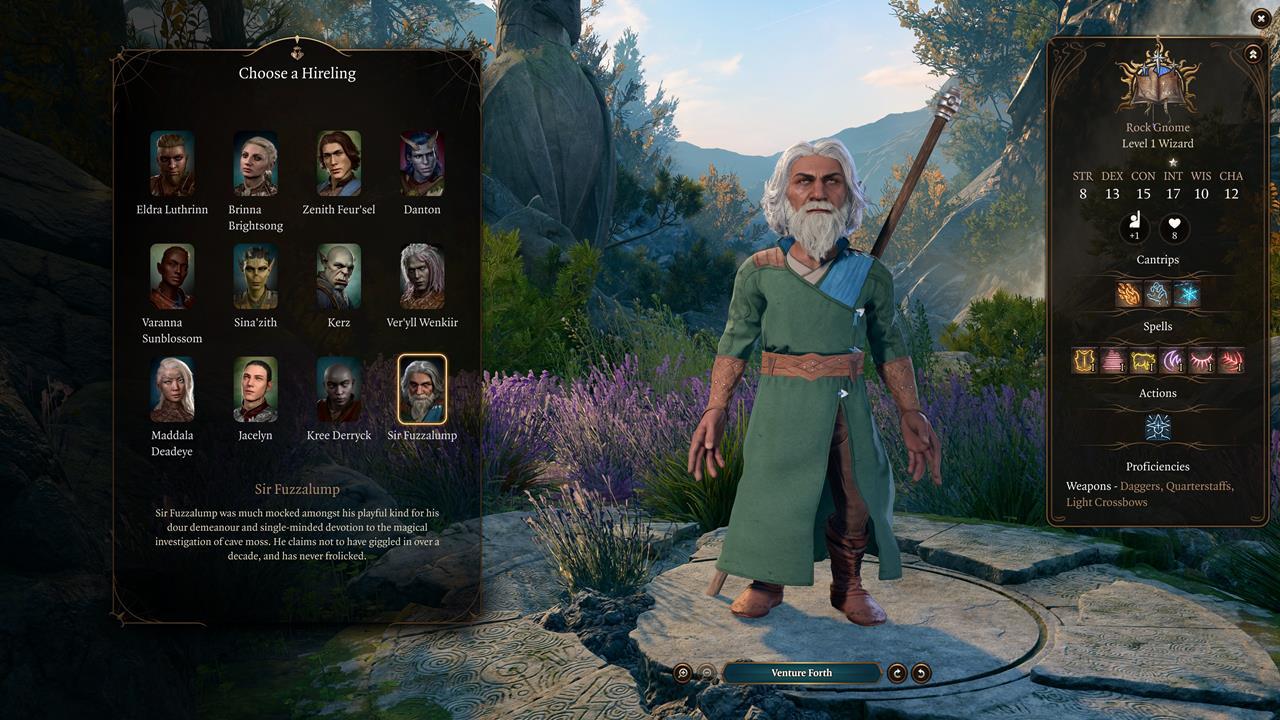
I play Baldur’s Gate 3 a lot, and I use Hirelings when I need exact roles filled. They’re simple mercenaries you can shape to your needs, and they save you from juggling companion drama. In my experience, they let you try bold class mixes without breaking the story threads.
- What Hirelings do (short)
- How you get them — the facts
- Why use Hirelings? (short answer)
- Where they shine (and where they don’t)
- List of standard Hirelings
- Customizing — what to tweak and why
- Sample builds and combos (practical)
- Hireling vs Companion — choose consciously
- Managing many Hirelings (real tips)
- Final practical notes (short)
What Hirelings do (short)
Hirelings are recruitable NPCs that you can fully customize after hiring. They don’t have personal quests, romances, or banter. That sounds cold, but honestly, that lack of story makes them reliable tools in fights and flexible party pieces.
How you get them — the facts
Find Withers first. He appears in the Dank Crypt near the Ravaged Beach or later at camp. Once he’s at camp you can hire mercenaries for a one-time 100 gold fee each. As of June 1, 2025 the system still works this way (I verified it in my March playthrough), and Withers can resurrect fallen Hirelings for a fee if you’re careless.
Why use Hirelings? (short answer)
Want a healer right now? Need a tank for a boss? Don’t want approval drama? Hirelings jump in at your level and you control their spells, feats, and progression. We found they’re especially handy for testing ideas fast. But, depends on your niche — some players hate the mechanical feel and prefer companions for story.
Where they shine (and where they don’t)
Hirelings shine when you want raw function over narrative. They’re the best choice if you’re optimizing for raids, tight encounters, or split-party experiments. Controversial take: if you chase pure power, Hirelings beat many companions for late-game builds. Some will call that “ruining immersion.” I say — to be fair — it’s a playstyle choice.
List of standard Hirelings
| Name | Race | Class | Primary Stat |
|---|---|---|---|
| Eldra Luthrinn | Gold Dwarf | Barbarian | Strength |
| Brinna Brightsong | Lightfoot Halfling | Bard | Charisma |
| Zenith Feur’sel | High Elf | Cleric | Wisdom |
| Danton | Tiefling (Mephistopheles) | Druid | Wisdom |
| Varanna Sunblossom | Wood Half-Elf | Fighter | Str/Dex |
| Sina’zith | Githyanki | Monk | Dex/Wis |
| Kerz | Half-Orc | Paladin | Str/Cha |
| Ver’yll Wenkiir | Drow (Lolth-sworn) | Ranger | Dex/Wis |
| Maddala Deadeye | Human | Rogue | Dexterity |
| Jacelyn | High Half-Elf | Sorcerer | Charisma |
| Kree Derryck | Duergar | Warlock | Charisma |
| Sir Fuzzalump | Rock Gnome | Wizard | Intelligence |
These pairings give sensible racial boosts for their roles. For example, a Gold Dwarf Barbarian resists poison and soaks a hit better, and the High Elf Cleric often has an extra cantrip (small but useful). You can’t change race or base class, but subclass, feats, spells, and equipment are all yours.
Customizing — what to tweak and why
When a Hireling joins, open their sheet. Pick subclass if due, allocate ability improvements, and choose feats. I’ve noticed players skip planning and regret it later. Why plan? Because a Life Domain Cleric with high Wisdom and heavy armor will actually keep your party alive; a Light Domain Cleric built for blasting will do different work entirely.
“Pick a role first. Then build toward it.” — my quick rule.
Key items to manage (short):
- Subclass choice — defines playstyle.
- Ability scores — matter for attacks and spells.
- Feats — can radically change performance.
- Gear — poor weapons hold back even the best builds.
Tip: use Withers’ respec option (if available) to rebuild a Hireling from level 1. It’s expensive but lets you correct early mistakes. There are exceptions — not every mistake needs a full respec.
Sample builds and combos (practical)
Here’s what I actually run when I need clean synergy. Try one of these and tweak by playstyle.
- “Radiant Nuke”: Zenith (Light Cleric) + Jacelyn (Sorcerer, metamagic focusing on quickened spells) + Varanna (Battle Master) + your main char as frontline. Works when you want burst radiant damage.
- “Stealth Strike Team”: Maddala (Rogue) + Ver’yll (Gloom Stalker Ranger) + Sina’zith (Monk/Shadow) — great for ambushes and theatrical one-shot kills.
Code example (tiny build snippet):
{
  "name":"Zenith",
  "class":"Cleric",
  "domain":"Life",
  "wis":18,
  "feats":["War Caster"]
}
Hireling vs Companion — choose consciously
Companions give story, reactions, and special quest rewards. Shadowheart or Gale add narrative weight and sometimes unique items or dialogue paths. Hirelings give mechanical freedom and zero fuss. Which is better? Depends. I prefer companions when I want immersion, Hirelings when I need a role filled cleanly. You might disagree — and that’s fine!
Managing many Hirelings (real tips)
Track equipment outside the game if you swap often. I keep a simple screenshot folder and name items in-game like [TANK] or [HEALER] for quicker sorting. Use the camp chest for role sets. We found rotating Hirelings every few big quests keeps levels balanced.
Long rests matter more with many characters because resources split across copies. Plan rests around major encounters. Also: you can dismiss and rehire later; the 100 gold cost is tiny by mid-game, so experiment freely.
Final practical notes (short)
Hirelings are tools. Use them when you want function. Use companions when you want story. I’ve noticed that mixing both gives the best results more often than choosing one style strictly. Watch this: sometimes swapping in a Hireling for a single boss fight changes the whole experience. Weird, but true.
One last opinion (controversial): min-max culture treats Hirelings like loadouts, which can strip the game’s emotional punch — and that matters to a lot of players. Between us, I still hire them. They save time, and time is precious.
Questions about a specific Hireling build? Ask me which exact feats or spells I’d pick for that character and I’ll show you a setup (fast).