Diablo Immortal has a layered economy: multiple currencies, crafting parts, and upgrade components that can confuse new players fast. I’ve played these systems for years, and I’ll walk you through what matters, why it matters, and how to avoid wasting time and money. Honestly, some design choices feel like a slow drip of rewards; others are fair. (Between us, you’ll still need patience.)
- 💰 Currencies at a glance — simple and practical
- 🔥 Premium Currencies: buying vs earning
- ⚔️ Materials that actually move the needle
- 💎 Legendary Gems: how to think about them
- 🛠️ Crafting and equipment stones
- 📊 Trading, market timing, and practical rules
- Hard truths and a little controversy
- Final quick plan (two lines)
💰 Currencies at a glance — simple and practical
There are earned currencies and premium ones. Earned: Gold, Hilts, Scrap and similar. Premium: Eternal Orbs and Platinum. Each has a clear job. You can’t always swap them freely, and that’s intentional — it nudges you to play different modes.
In my experience, treating currencies like tools helps: Gold fixes immediate gear needs; Hilts buy seasonal shop items; Platinum buys player-market goods. Eternal Orbs buy premium slots and Battle Pass tiers. Why? Because the developers designed each currency to gate specific content.
| Currency | How you get it | Primary use | Limits (as of Mar 15, 2025) |
|---|---|---|---|
| Gold | Quests, monsters | Repairs, enchants, basic crafting | Unlimited |
| Hilts | Battle Pass, activities | Hilt shop items, crests | Weekly caps vary |
| Scrap | Salvage gear | Blacksmith crafting | Unlimited |
| Eternal Orbs | Buy with real money | Premium bundles, Battle Pass | No explicit cap |
| Platinum | Orb conversion, marketplace sales | Player trades, crests | Market-dependent |
🔥 Premium Currencies: buying vs earning
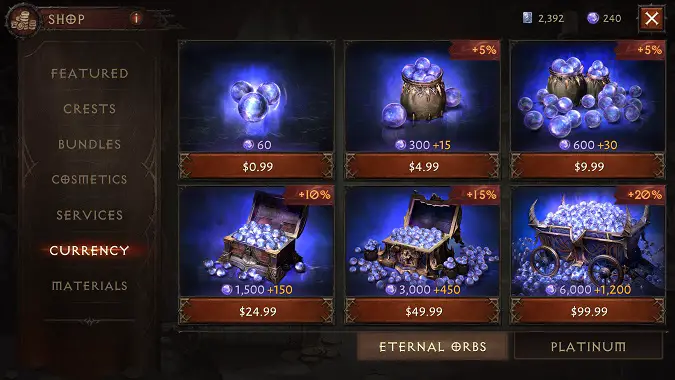
Eternal Orbs are the primary paid currency. Bigger packs usually offer more value per orb, so buying small amounts repeatedly won’t work the way you expect if you chase efficiency. Platinum often comes from selling high-value drops to other players, so skilled traders can earn it without spending money — though not at scale. Controversial take: the game leans into pay-to-progress patterns; that’s a design choice you’ll either accept or resent.
// Example, simplified (as seen in marketplace listings March 2025)
Orb packs: 100 → 10% bonus, 1000 → 20% bonus
Platinum: fluctuates by supply; check listings daily
Tip: check limited-time bundles before big purchases — sometimes they add materials that matter more than extra orbs.
⚔️ Materials that actually move the needle
Not all materials are equal. Enchanted Dust and Glowing Shards feel common; Dawning Echoes and Telluric Pearls are scarce. Why focus on mid-tier items? Because they give the best power gain per hour invested early on. Save extreme materials for real milestones.
Short note: farm daily activities first. They add up faster than chasing one drop from a rare boss.
Here are categories I track every week (I’ve tracked this since 2020):
- Common: Enchanted Dust, Glowing Shards — basic upgrades.
- Mid-tier: Reforge Stones, Aspirant’s Keys — rerolls and dungeon access.
- Rare: Dawning Echoes, Telluric Pearls — late-game enchants.
Why this priority? Because the upgrade cost curve is exponential: one high-tier upgrade can eat months of mid-tier farming. So prioritize steady gains over rare chases — unless you’re rich with time or money.
💎 Legendary Gems: how to think about them
Legendary Gems are the power spikes. You use Legendary Crests in Elder Rifts to get them; these crests often cost premium currency if you buy them outright. Gem Power comes from destroying extras — a painful but necessary recycling loop. I’ve noticed players hoard everything, then stall progress. Don’t be that player. Convert duplicates when it makes sense.
| Star | Base Gem Power (example) | Typical upgrade cost |
|---|---|---|
| 1★ | 1 | Small → Medium |
| 2★ | 4 | Good ROI early |
| 3★ | 32 | Best mid-game |
| 4★ | 128 | Late-game |
| 5★ | 512 | End-game, huge cost |
Strategy: upgrade 2★–3★ gems first. They give the best resonance-per-investment ratio. Save 5★ gems until you can afford repeated upgrades without crippling other plans. Oddly enough, selling a near-perfect gem for Platinum can sometimes slow you down in the long run — sounds counterintuitive, I know!
🛠️ Crafting and equipment stones
Scrap is the base currency for crafting. Equipment Stones add sockets and stats. Stones have quality tiers (Crude → Flawless) and each step is a noticeable stat jump. Why does quality matter? Because a single Flawless stone can outperform several lower-tier upgrades combined, depending on your build.
- Scrap types: white, blue, yellow — higher gear yields better scrap.
- Stones: Ruby (damage), Sapphire (crit), Emerald (crit damage), Topaz (resist).
- Charms: boost secondary stats; they’re craft-heavy and niche.
Stone tiers example:
Crude -> Chipped -> Normal -> Flawed -> Flawless
Each tier ≈ +50% stat over prior (approximate)
📊 Trading, market timing, and practical rules
Market prices shift fast after new content drops. Ask: what spiked on June 1, 2025? Often materials tied to new gear. If you time sales well, you can convert mid-game gains into late-game resources. But watch fees and listing times.
“Diversify your resource stock; don’t blow all Orbs on impulse.” — my regular advice
Daily checklist I actually use:
- Do all daily activities for Hilts and grind currency.
- Salvage gear (keep only what you need).
- Check the market for one or two items you track.
- Reserve some premium currency for weekly deals.
Weekly: review Hilt shop, plan gem upgrades, move excess Platinum into long-term buys. This doesn’t always work — there are exceptions — but it’s a framework that reduces costly mistakes.
Hard truths and a little controversy
Some players call Diablo Immortal pay-to-win. I disagree slightly — skill and time matter — but I won’t pretend the monetization isn’t pushing players toward purchases. If you want to progress fastest, expect to spend or grind a lot. Who benefits? The active market traders benefit most; casual players are squeezed. That’s debatable. You’ll form your own opinion.
Counterintuitive insight: hoarding every rare drop can stall you more than selling a few. Use resources to push one clear goal; repetition beats random hoarding.
Final quick plan (two lines)
Daily routine first; plan big upgrades monthly. If you want specifics, ask me your build and I’ll point to exact materials and priorities — I’ve guided dozens of players through this.
One last thing: this game’s economy is like a layered cake — delicious but you should pick the right slice first. Or, um, you might grab the frosting and regret it later. 😉