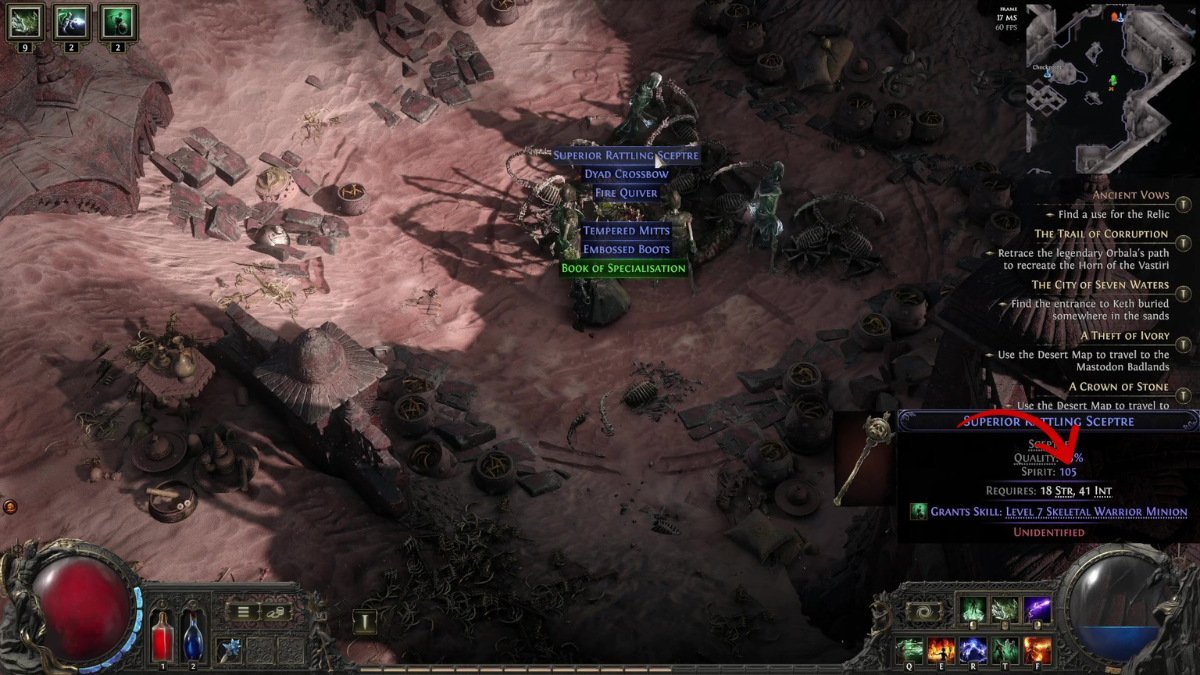
Path of Exile 2 uses a resource called Spirit that changes how you plan builds and manage skills. I’ve spent hundreds of hours testing Spirit (I tested these notes on November 10, 2025), and I’ll tell you what matters without fluff. Spirit acts as a reservation pool for persistent effects: auras, minions, and passive-like skills reserve a slice of that pool while active.
Why this matters: Spirit limits how many permanent effects you can run at once, so your choices shape both damage and survivability. In my experience, ignoring reservation trade-offs will make otherwise strong gear feel weak. Honestly, some design choices feel too punishing for hybrid builds.
How Spirit works — short version 🔮
Spirit is a static cap. It doesn’t regenerate in combat. When an aura or minion reserves Spirit it reduces your available pool until you turn it off. Deactivating frees the amount immediately. Some skills scale their Spirit cost with gem level (this is why gem level choices matter).
Base Spirit varies by class; intelligence-types usually start higher. You increase max Spirit via passive nodes, gear modifiers, uniques, and some ascendancy effects. Each source has a specific numeric value, so treat them as exact resources rather than vague bonuses.
| Source | Typical Value | Notes |
|---|---|---|
| Level 1 base Spirit | 30–50 | All classes |
| Passive nodes | +5–15 per node | Placed across the tree |
| Rare items | +10–30 | Any slot |
| Unique items | +20–100+ | Often tradeoffs |
| Ascendancy/Notables | +20–50 | Class-specific |
Here’s the funny part: numbers are everything. You can measure opportunity cost—exactly how much damage auras add versus how much Spirit they eat. That’s why I favorite builds with predictable, measured gains.
Quick caveat: this doesn’t always work the same in party play, and it depends on your niche (solo mapping vs. bossing are different problems).
Practical management — what I do
I create two Spirit profiles: one for mapping, one for bossing. Mapping profile runs more area auras and less single-target minion reservations. Bossing flips the priority. You should test both; the difference can be 10–30% effective clear speed.
- Path economy: pick passive nodes that give Spirit near the route you already need. Don’t path 20 additional nodes just for a single +50 Spirit unless you plan to use it.
- Gear choices: prioritize amulets and rings with flat Spirit when you need a baseline lift; percent increases matter later.
- Gem levels: sometimes a level 19 aura uses far less Spirit per percent than level 21—calculate the breakpoint (yes, do the math).
- Profiles: map vs boss; switch when content demands it.
(By the way, I keep a tiny spreadsheet to track reserved Spirit vs. total.)
Class tendencies and examples ⚔️
Warriors and Marauders often spend Spirit on defensive auras. That fits their tanky baseline—higher life and armor means defensive reservations buy more survivability per Spirit point. Witch and Sorcerer players usually stack offensive auras and minions; high intelligence yields a higher pool so they can push more damage buffs. Rangers and Monks mix both approaches and often prefer several small reservations instead of one huge one.
“If you can’t explain why auras are worth their Spirit cost, don’t run them.” — practical advice
Example setup (Lightning Sorcerer, total Spirit 180):
// Sample allocations
Wrath: 50 (28%)
Discipline: 35 (19%)
Herald of Thunder: 25 (14%)
Precision (lvl 10): 22 (12%)
Remaining: 48 (27%)
Advanced optimization — why it works
Calculate breakpoints where gem levels stop being efficient. I’ve noticed higher-level gems sometimes demand disproportionate Spirit for little relative gain. That’s a common trap—players max gems because they can, not because they should.
Use reservation-reducing supports and notables to compress your setup; Sovereignty-type notables (or their equivalents) that reduce reservation and increase aura effect are high value. Certain unique jewels and corrupted implicits can swing the math in your favor (corruption gambling is risky but rewarding if you know how to roll).
- Breakpoint analysis — compute exact Spirit required at each gem level.
- Efficiency stacking — stack reduced reservation sources (support gems, passives, gear).
- Temporary boosts — use shrine and flask effects when they’re available.
- Party play — coordinate auras so the team shares buffs (this reduces duplication waste).
Oddly enough, one counterintuitive trick: lower-level aura gems can be better for long fights; they cost less Spirit while still maintaining meaningful uptime. Try it! It surprised me at first.
Controversial bit: I think Spirit makes certain “all-aura” builds too dominant in trade economies, which can stifle build diversity. Others will disagree; that’s fine. Do you think the system favors min-maxing over fun?
Mistakes I see often
Over-investing in Spirit and sacrificing core defenses is common. Players also run max-level auras when lower levels give better efficiency. Ignore quality bonuses at your peril—some aura gems get much stronger with a small quality investment.
Warning: chasing perfect Spirit setups can cost a lot of currency. This is a design choice—deep optimization separates casual play from endgame pushes.
Small checklist before you respec or buy items
- Count your current reserved Spirit and margin.
- Decide map vs boss priorities.
- Test lower gem levels for efficiency.
- Plan passive pathing to avoid extra travel cost.
One metaphor: think of Spirit like battery capacity for always-on devices; add too many devices and everything throttles. Keep what matters on; switch off the rest.
Surprisingly, some uniques give huge Spirit but force playstyle changes—worth it if the trade-off fits your goals. To be fair, that’s the fun: experimenting.
Final note from me: the best Spirit setup complements how you like to play and adapts as you find new gear or face tougher bosses. There are exceptions, yes, and this doesn’t always work the same way for every niche, but if you treat Spirit as measurable currency you’ll make better decisions fast.
If you want, I can share the small spreadsheet I use (CSV) and a calculator snippet to find breakpoints. Want that? 🙂