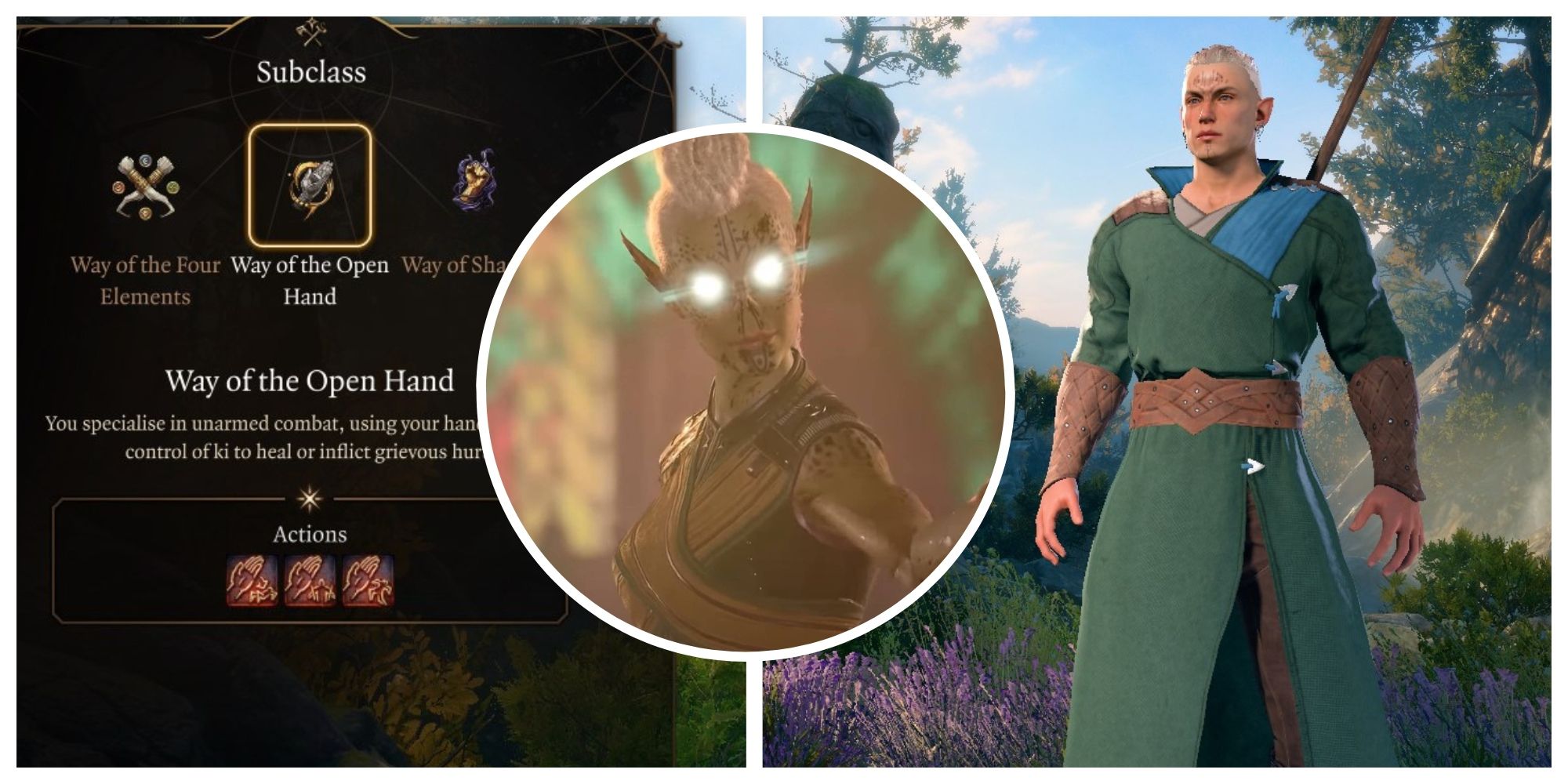
Monks in Baldur’s Gate 3 move fast and strike harder than most classes. I’ve played them since 2023 and I can tell you: the subclass you pick changes how you play every encounter. I write from experience — I’ve tried all three paths, tested builds on Act II fights, and adjusted for party comps (yes, there are exceptions).
Which subclass should you pick? It depends on your goals: do you want raw control, stealth tricks, or elemental options? Honest opinion: Open Hand is the safest pick for most players, but Shadow and Four Elements have moments where they outshine it. Surprising, right?
Way of the Open Hand — Reliable control, big payoff 👊
Open Hand gives strong melee control. You’ll push, trip, and lock targets down so your teammates land hits. In my experience, the Topple options (combined with Flurry-style combos) create easy kills on enemies you pin near cliffs or hazards.
Why pick it? Because it turns positioning into a damage multiplier: prone enemies grant advantage to allies, which in turn increases crit chances and sustained pressure. You also gain Wholeness-style self-heals that scale with level — that matters in long dungeons where resources run low.
Quick tip: force enemies over environmental hazards (chasms, flames) rather than relying only on damage. It’s efficient and—between us—very satisfying!
Way of Shadow — Stealth, mobility, and setups 🌑
Shadow monks play like assassins. They swap ki for useful stealth spells and get Shadow Step for fast repositioning (roughly 18 meters). That teleport gives advantage on the follow-up attack more often than you’d think.
Pairing note: Shadow shines with a Warlock who uses Devil’s Sight or any teammate who can cast Darkness. I’ve seen single encounters crumble when a coordinated Dark zone and a Shadow monk target the enemy caster. Controversial point: some players call Shadow a gimmick — I disagree; it’s elite when the party plans around it.
| Spell / Utility | Use | Notes |
|---|---|---|
| Pass Without Trace | Group stealth | Great for infiltration (keeps noise down) |
| Darkness | Control | Pairs with Devil’s Sight for near-invulnerability |
| Silence | Shut down casters | Use it to stop ritual or channel spells |
Way of the Four Elements — Elemental toolbox 🔥
Four Elements mixes ranged attacks and AoE magic into monk gameplay. It costs more ki per effect than other subclasses, so you’ll need tidy ki management. That’s the catch—this path can feel expensive, and sometimes you’ll wish you’d taken a different subclass.
That said, spells like Fangs of the Fire Snake extend reach and add consistent extra damage, while Water Whip and similar effects pull or control groups. At higher tiers, access to wider AoE changes how you position in fights; you can soften groups before they close.
// Example quick macro for an Open Hand burst
if (stunned or prone target) {
  use FlurryOfBlows();
  use ToppleIfAvailable();
}
Oddly enough, Four Elements can out-DPS Open Hand in large rooms with clustered mobs. Counterintuitive? Yep. There’s a trade-off: burst versus sustainable control.
Stats and how they matter 📊
Short: Open Hand = control + steady damage. Shadow = mobility + utility. Four Elements = AoE and reach. Which is best depends on your composition and what you face on a given day (or patch).
- Open Hand: top single-target control.
- Shadow: best for surprise and repositioning.
- Four Elements: top for AoE bursts in clustered fights.
(This doesn’t always work—depends on your niche and party synergy.)
Multiclass thoughts — practical, not theoretical 🎭
Multiclassing often looks tempting, but it can delay key monk features. I’ve found small dips are useful: one level of Fighter for Action Surge helps Open Hand land extra Flurries in a turn. Two Rogue levels give Shadow extra Sneak Attack and Cunning Action; yes, it’s redundant sometimes, but it’s deadly in ambushes.
“If you multiclass, plan the breakpoint where you stop — don’t chase every feature.” — from my playtests
- Open Hand 11 / Fighter 1 — burst windows.
- Shadow 10 / Rogue 2 — assassinate on command.
- Four Elements 9 / Druid 3 — spell access and utility (more complex).
One last frank note
Open Hand is my default recommendation for most players; it handles both solo play and party roles with less fuss. That said, Shadow can trivialize encounters when the team coordinates—if your group doesn’t plan, Shadow won’t work the way you expect. Four Elements rewards careful ki budgeting and puzzle-like combat decisions.
So what should you do right now? Pick based on how you want to play. Want control and low fuss? Open Hand. Love positioning and tricks? Shadow. Like casting with punches? Four Elements. Want my final take in one sentence: choose the path that makes fights feel fun for you, not the one everyone else says is “meta” (meta changes fast, trust me!).
Updated March 14, 2025. If you want, I can share a level-by-level build (with numbers and gear) for the subclass you pick — want that? 😊