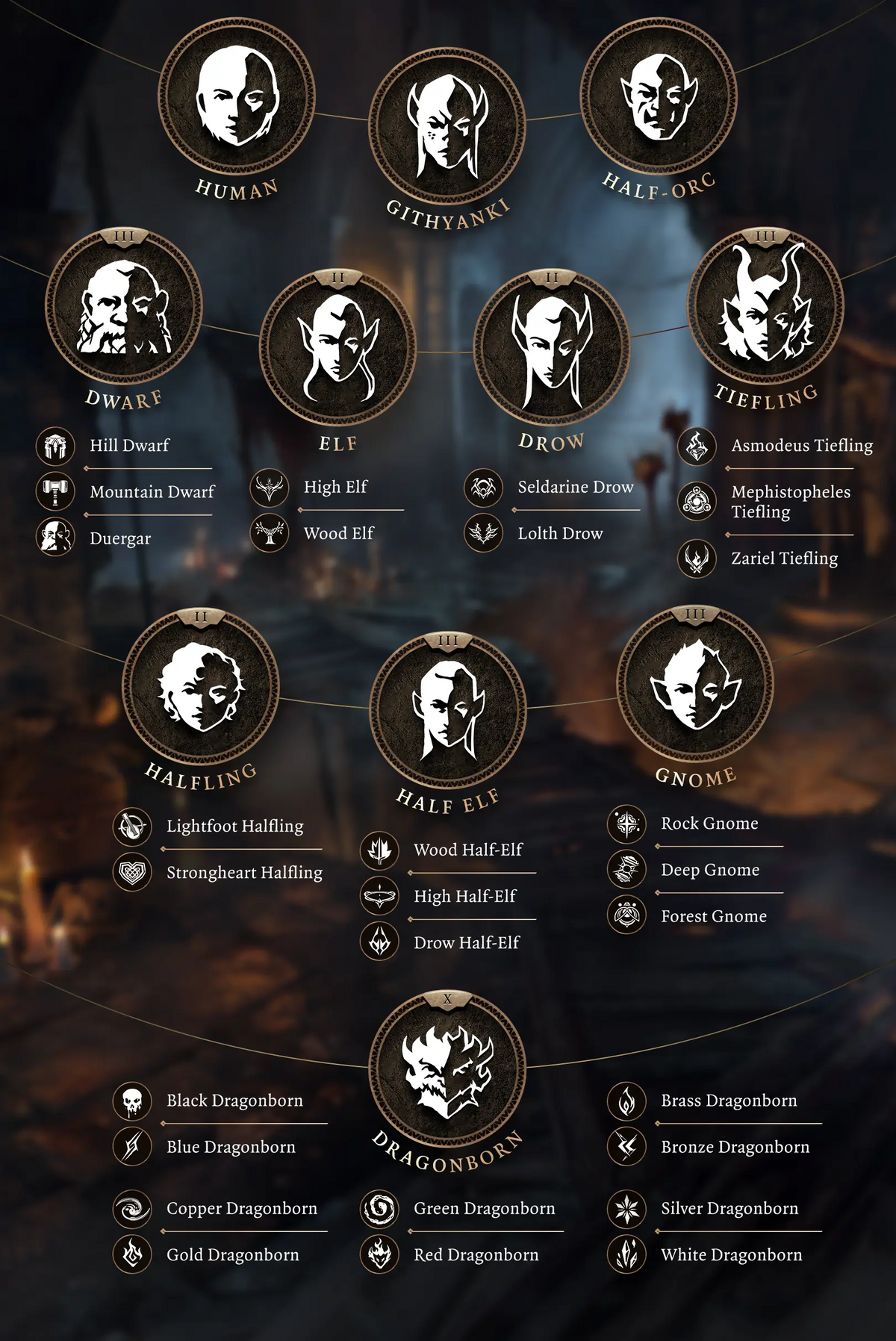
Choosing a race in Baldur’s Gate 3 shapes more than stats — it changes how you move through stories and fights. I’m an experienced player and designer; in my experience the right race often solves mechanical headaches and makes roleplay feel natural. I’ll be direct: pick what supports your core idea for the character, and pick with the why in mind.
Quick caveat: this reflects the game as of 2025-11-24 and depends on your niche and build (there are exceptions). Some combinations that look optimal on paper won’t work the way you expect in practice—trust me, I’ve wasted good builds on bad synergy.
🧝 Elves — dexterous, alert, and varied
All Elves get +2 Dexterity and Darkvision to 18 meters (60 feet). They also have Fey Ancestry: advantage on saves vs. charm and immunity to magical sleep. In my experience, that last bit saves you from cheap TPKs more than you’d think.
High Elf: +1 Intelligence and one wizard cantrip. Great for Wizards and multiclass trickery because that cantrip is free resources (control or utility).
Wood Elf: +1 Wisdom and +1.5 meters movement (the game shows faster base speed); proficiency in Perception. Scouts and Monks love this for map control and open-field fights.
Honestly, Wood Elf monks sprint past problems; High Elves let you start with flavor magics. Which do you want — speed or extra intellect?
🛡️ Dwarves — tanky, steady, sometimes underrated
All Dwarves: +2 Constitution, Darkvision 18m, Dwarven Resilience (advantage on poison saves and resistance to poison). Base movement is lower, but that hardly matters when you’re front-line locking enemies down.
| Subrace | Bonus | Key Trait |
|---|---|---|
| Gold Dwarf | +1 Wisdom | +1 HP per level |
| Shield Dwarf | +2 Strength | Light & Medium armor proficiencies |
| Duergar | +1 Strength | Superior Darkvision (36 m), advantage on certain saves |
The Shield Dwarf effectively gives you heavy-hitting durability without needing feats. Gold Dwarves are clutch for Wisdom-caster survivability. Duergar bring superior darkvision (36m) and Underdark tricks — watch this: they often out-scout “stealthy” builds underground.
🎭 Half-Elves — flexible faces and skill machines
Half-Elves get +2 Charisma and +1 to two other ability scores you choose. They also gain two skill proficiencies of your choice. We found this versatility makes them the easiest to slot into parties.
Pro tip (between us): for new players, those two skills are more valuable early than tacking +1s to obscure stats. Why? Skills let you handle dialogue, traps, and social scenes without reloading all the time. Unexpected, right?
Advice: If you want to be the party face, pick Persuasion plus one utility skill. It’s that simple.
⚔️ Humans and Githyanki — simple and brutal
Humans: +1 to every ability score and one skill proficiency. They’re balanced; you won’t get extreme bonuses, but you won’t have glaring weaknesses either. I’ve noticed players underrate Humans—sometimes adaptability matters more than a stat edge.
Githyanki: +2 Strength, +1 Intelligence, armor proficiencies, and martial weapon proficiencies. They also have Githyanki Psionics: Mage Hand at level 1, Jump at 3, Misty Step at 5 (as of 2025-11-24). Astral Knowledge grants a skill proficiency that refreshes after a long rest — very strong for a one-person toolbox.
Controversial take: Githyanki are overrated in roleplay; mechanically they’re great, but they can pigeonhole you into warrior tropes. Some players call them OP — I think they’re just straightforward.
🐉 Dragonborn — raw offense with a niche defense
Dragonborn: +2 Strength, +1 Charisma. Breath Weapon and resistance to its damage type. Breath starts at 2d6, increases by +1d6 at levels 6 and 11. Save DC = 8 + Con mod + proficiency. That means Constitution is a useful secondary stat.
Ancestry determines damage and shape. Example: Red (fire, 3m cone), Blue (lightning, 9m line). Resistances change play—pick one that complements your party, or you’ll feel like a squishy tank trying to drive a truck through a paper door.
🌙 Tieflings — infernal flair and spell toys
Tieflings all get +2 Charisma and Darkvision 18m. Subraces tie to archdevils and grant spells and resistances. Here are the typical setups (as of 2025-11-24):
- Asmodeus: +1 Int, fire resistance, Thaumaturgy, Hellish Rebuke at 3, Darkness at 5.
- Mephistopheles: +1 Int, fire resistance, Mage Hand, Burning Hands at 3, Flame Blade at 5.
- Zariel: +1 Strength, fire resistance, Thaumaturgy, Searing Smite at 3, Branding Smite at 5.
Why choose one? Because the spell list changes your combat tempo and roleplay hooks. Zariel gives you melee punch; Asmodeus gives reactive damage; Mephisto is tricky for mixed casters.
Want a short checklist? (Yes?)
- Pick race that supports your primary stat and role.
- Think about movement and senses—darkvision ranges matter underground.
- Consider party composition: don’t make two utility gnomes when you need a tank.
// Tiny example: Breath DC calc (standard)
breathDC = 8 + conMod + proficiencyBonus;
Here’s the funny part: mechanically optimal isn’t always the most fun. I’ve built a dragonborn bard once. It felt ridiculous, and I loved it! Unexpected wins like that are how memorable stories start.
“Play what makes scenes feel inevitable, not just what rolls highest.” — my usual credo
One debatable point to leave you with: racial bonuses will feel less decisive once you hit high levels and multiclass freely. So, are you optimizing for level 1 or level 20? That question matters more than people admit.
Final quick tips: experiment (this doesn’t always work, but try anyway), read your racial traits, and think about why you want the role, not just the numbers. To be fair, sometimes you’ll change your mind mid-playthrough — it happens. Go make something interesting. May your rolls be merciful!