I play Bard in Final Fantasy XIV: Shadowbringers and I want to tell you how to play it well, plainly and from experience. Bard is a ranged physical DPS that also gives real support to the party. If you focus only on button presses you’ll miss the job’s point: it’s about timing, choices, and small trade-offs that add up to big results.
Song cycles sit at the center of Bard play. You rotate through Mage’s Ballad, Army’s Paeon, and The Wanderer’s Minuet on a roughly 120‑second loop. Each song changes how you act; use them to align burst windows with raid buffs and movement. Why bother? Because good song timing turns average hits into windowed damage that wins fights (I’ve seen it dozens of times).
🎵 Basics and mindset
Keep DoTs up on your main target. Keep songs running unless you have a reason to reset. Use instant skills while moving. These are simple rules that matter more than memorizing every combo.
Honestly, Bard’s complexity isn’t flashy—it’s repeated decision-making. You choose between a personal DPS gain and a small party help. Sometimes you pick the latter; depends on your niche and the fight.
📊 Stats and gear (as of 26 November 2025)
Here are target ranges I use on raid-caliber gear (8‑man) — adjust if you’re in lower-tier content or different encumbrances. These are practical, not theoretical.
| Stat | Typical Range | Why it matters |
|---|---|---|
| Critical Hit | ~2400–2800 | Boosts damage spikes and song procs |
| Direct Hit | ~1800–2200 | Consistent flat damage increase |
| Skill Speed | ~1200–1400 | Sets your GCD and burst alignment |
| Determination | Remainder | Useful filler stat |
Controversial? I’ll say it: Crit isn’t always the only stat to chase. Some fights favor Direct Hit or lower Skill Speed so you hit timed buffs cleanly. Fight and gear matter—there are exceptions.
🎯 Core rotation (practical opener)
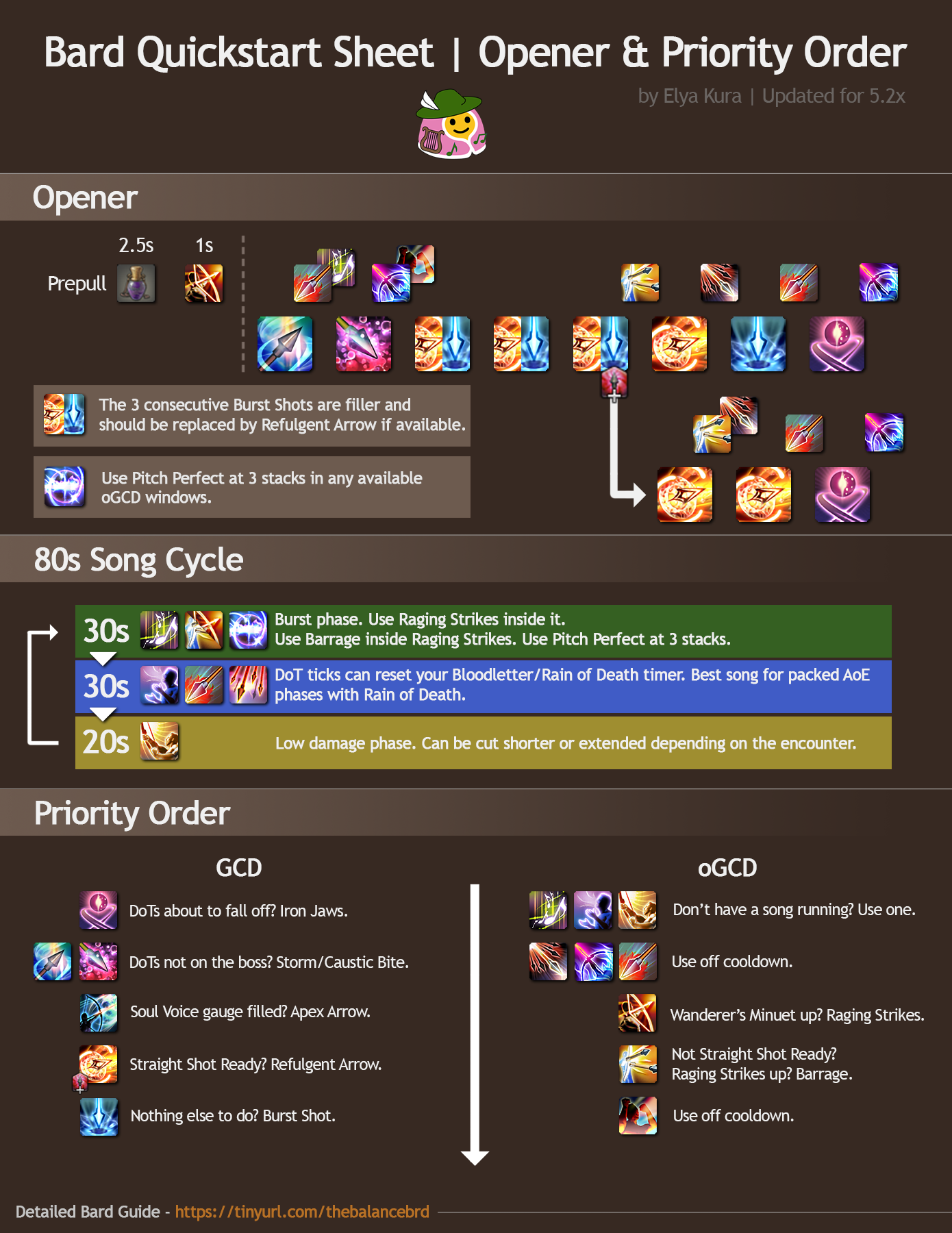
Short version: pre-pull Stormbite, open with The Wanderer’s Minuet, set your DoTs, then burn during raid buffs. Keep song timers aligned to avoid wasting Pitch Perfect.
// rough opener timeline (seconds)
-5s: Stormbite
 0s: The Wanderer’s Minuet → Caustic Bite
 5s: Raging Strikes → Barrage → Refulgent Arrow
 ...maintain DoTs, fish Pitch Perfect stacks
During Minuet phases you fish for Pitch Perfect at 3 stacks most of the time. Use Empyreal Arrow on cooldown—it’s reliable. If the song is ending, use at 2 stacks to avoid waste. These small choices change your average damage.
Advanced play: weaving and procs
Weaving oGCDs between GCDs is a skill you grow into. Single weaves are the norm; double weaves for openers or heavy proc windows. Don’t clip your GCDs. You’ll learn when to double weave by feel—practice until it’s natural.
Proc priority matters: keep DoTs highest, then avoid wasting Pitch Perfect, then spend charged abilities before they cap. During busy moments you may sacrifice perfect weaving to avoid losing a bigger resource—trust me, that trade-off is worth it.
Tip: If you lose a Pitch Perfect stack because you panicked, it’s okay. Reset and move on. We all do it.
💡 Utility and party help
Nature’s Minne boosts healing potency on a target—use it on the main healer during big raid damage, or on a tank for busters. Warden’s Paean blocks or cleans debuffs; time it for specific mechanics. Battle Voice should land during coordinated burns to boost everyone’s criticals.
Why time these? Because a well-placed Minne can save MP and prevent healer panic. A missed Paean can cost a wipe. Communicate with your healers; tell them when you plan to use Minne (to be fair, they’ll often tell you back).
- Minne: tanks for single heavy hits; healers for raid damage.
- Paean: doom windows, persistent DoTs, mechanics that need an immunity.
- Battle Voice: synchronized burn phases.
There’s a catch: don’t trade huge personal DPS for tiny support benefits unless the encounter requires it. This doesn’t always work any other way.
⚔️ Savage tips
In Savage you must be precise. Save cooldowns for known burn windows. Positioning matters—pre-position so you don’t lose GCDs during movement. Talk to your raid about Minne timing and who gets cleans.
| Phase | Bard priorities |
|---|---|
| Pull/Opener | Hit perfect rotation, align buffs |
| Mechanics | Keep uptime, use utility |
| Burn | Max burst, use cooldowns together |
Practice your rotation until it’s muscle memory. If you’re not logging and reviewing, you’re leaving progress on the table. Who wants that? (No one.)
Practical examples and a counterintuitive note
Small example: sometimes a slightly lower Skill Speed that keeps your GCD at 2.48s is better than chasing tiny Stat upgrades that misalign your burst. Oddly enough, slowing down can boost average DPS when it syncs your windows better.
// weave pattern examples
GCD → single oGCD → GCD   (normal)
GCD → double oGCD → GCD   (opener/proc-heavy)
Unexpected insight: if your team can adapt, you can intentionally shorten a song to shift a burst into an easier phase of the fight. It sounds risky, but we found it pays off on certain fight timers.
Final, short notes
Becoming a strong Bard takes practice and patience. Focus on fundamentals first: DoT uptime, song management, and sensible utility use. Then add weaves and micro-adjustments. I’ve coached players who improved dramatically just by fixing two or three small habits.
One more thing—don’t be afraid to ask for feedback in raid. People respect someone trying to get better. And hey, have fun with it; Bard is rewarding when you start making the right calls.
— a Bard main who’s been playing since 2019 (and still learning…)